 |
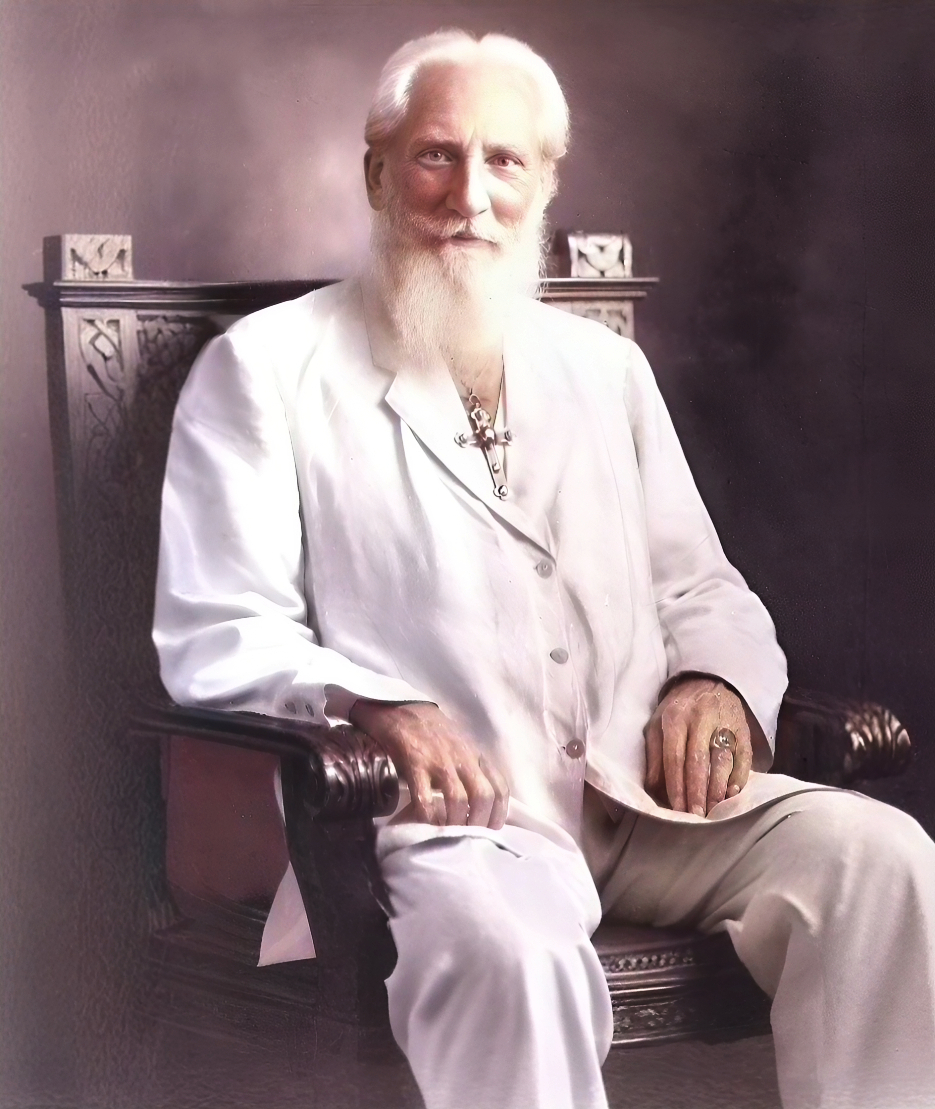
Biography Charles Webster Leadbeater was born in Stockport, Cheshire, England. His exact date of birth cannot be determined with certainty, as his birth certificate states February 16, 1854, while his passports lists February 17, 1847. In his youth, he worked in church positions until he was appointed deacon of the Church of England in 1878 and ordained as a priest there a year later. In the parish of Bramshott in Hampshire, he served as vicar to his uncle, the Reverend William Wolfe Gapes, who was not only a wealthy rector but also a respected classical scholar. Even back then, he worked with young people, undertaking many social and spiritual activities with them, and founded the youth group of a church-based temperance society. He was involved in high church, sacramental Anglicanism, but even at that time he was interested in supernatural things and attended séances and lectures on spiritualism. All of these interests later became focal points of his life and teachings. |
In 1883, he read the book The Occult World by Alfred Percy Sinnett which was a revelation to him. This impressive and readable book opened up new horizons for him and prompted him to contact the Theosophical Society in London, where he was accepted as a member on November 20, 1883. On February 20, 1884, he was then accepted into the London Lodge of the Theosophical Society.
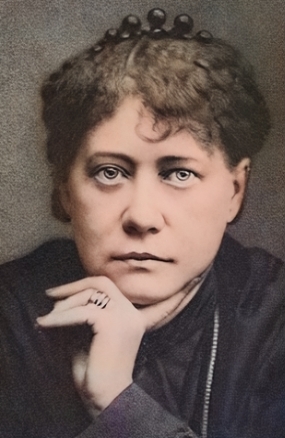
On April 7, 1884, Leadbeater met Helena Petrovna Blavatsky and Henry Steel Olcott at a turbulent election meeting of the London Lodge. He was so deeply impressed by Mrs. Blavatsky that from that day on he increasingly withdrew from the Anglican Church and turned to theosophy.
On October 31, 1884, shortly before Madame Blavatsky's return to India, he received a letter from the Ascended Master Kuthumi. The very next day, Leadbeater wrote him a reply, offering to give up his career in the church and go to India with Madame Blavatsky to serve Theosophy. He took this letter to her in London and then accompanied her to the Cooper-Oakleys' house, where, after midnight, a reply letter materialized in Madame Blavatsky's outstretched arm before his very eyes.
|
H. P. Blavatsky |
The letter suggested that he leave England immediately if he wished to do so and join her in Alexandria. He hastily resigned his priesthood, settled his affairs, and set sail for India on November 5, 1884. On the way there, he officially became a Buddhist in Colombo, Ceylon, before arriving in India in December 1884. From 1884 to 1888, he lived in Adyar, India. He studied theosophical teachings, was Olcott's assistant, and served as secretary of the Theosophical Society. During this time, the Ascended Masters awakened his clairvoyance by having him perform certain exercises, which they closely supervised. In 1889, Leadbeater spent most of his time in Ceylon, where he directed educational and theosophical work. He met the then 13-year-old boy Curuppumullage Jinarājadāsa, in whose aura he clairvoyantly perceived great spiritual maturity, which, however, required training in England. After some difficulties, he took the boy to England in 1889 and provided for his education there, and indeed the boy later became president of the Theosophical Society. |
In England, Leadbeater served as tutor to Jinarājadāsa, as well as to George Sydney Arundale, another later international president of the Theosophical Society, and Percy Edward Sinnett, the son of Alfred Percy Sinnett. Leadbeater and Jinarājadāsa lived at the Sinnetts' home in Notting Hill, London, for the next two years.
|
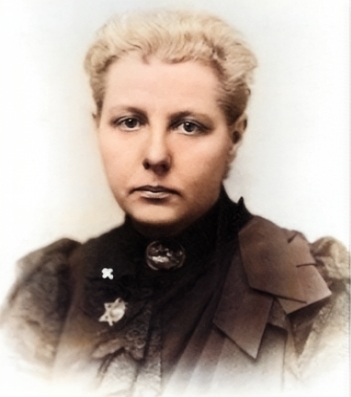
During his years in London, Leadbeater further developed his clairvoyance, deepened his occult investigations, and began writing books. In 1894, he published “The Astral Plane,” in 1895 “The Devachanic Plane”, and from 1895 to 1899, he collaborated with Annie Besant to write treatises that formed the basis for the book “The Occult Chemistry”, published in 1908. In these works, Mrs. Besant and he described their clairvoyant perceptions of the subatomic realm, which were only confirmed much later by science through the development of quantum physics. Together with Mrs. Besant, he also published the book "Thought-Forms" in 1905. This book, in which thought forms, moods, and feelings are depicted in vivid colors and abstract forms as they appear to the clairvoyant eye, also had a remarkable influence on modern art. |
Annie Besant |
In 1899, his book “The Christian Creed” was published, which, despite the antipathy of some theosophists, built bridges between Christianity and theosophy. His extensive lecturing activities led to the publication of his books "Man Visible and Invisible" (1902), "An Outline of Theosophy" (1902), and "The Other Side of Death" (1903).
Leadbeater lived in London until 1909, although he spent long periods of time on international lecture tours between 1896 and 1906. His brilliant lectures and impressive books increased his fame within the theosophical world. During this time, he was recognized by many as the greatest theosophical authority on supernatural phenomena.
In 1906, however, massive problems arose for the first time. He was accused of immorally teaching young people masturbation, which was a major scandal at the time, and demands were made for his expulsion from society. Leadbeater admitted that he had indeed taught this to young people in four cases because he had clairvoyantly seen the harm they were exposed to due to the pressure of their awakening sexuality and wanted to prevent them from going to prostitutes. From his point of view, he had done nothing wrong, yet Leadbeater voluntarily left the Theosophical Society to protect its reputation.
|
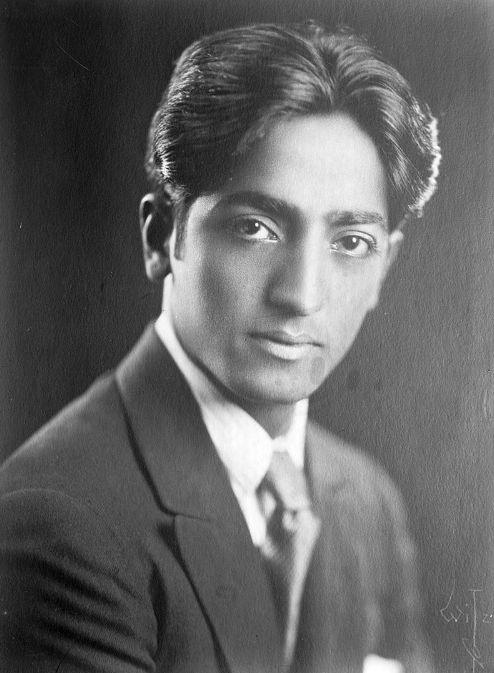
J. Krishnamurti |
He then lived in Italy, among other places, and pursued his clairvoyant investigations. In December 1908, after Mrs. Besant had become president of the Theosophical Society, its General Council voted to reinstate Leadbeater, and so he returned to Adyar. Over the next six years, he published some of his most important works there. In 1909, he discovered such spiritual potential in the aura of a boy that he was convinced that this boy could become the vehicle for the expected world teacher. This boy was Jiddu Krishnamurti, and he took it upon himself to nurture him. In 1910, the boy wrote the book "At the Feet of the Masters", which became a huge success and later a classic of theosophical literature. In the same year, The Order of the Star in the East was founded to prepare Krishnamurti for his future role as the vehicle for the World Teacher. |
In 1910 and 1911, the two volumes of the book “The Inner Life” were published, followed in 1913 by his book “The Hidden Side of Things.” In these works, he often addresses practical esoteric aspects of everyday life, emphasizing, for example, the harmfulness of meat and alcohol consumption and the importance of kindness toward children and animals.
In 1910, Leadbeater began clairvoyantly investigating the past lives of Theosophists and their karmic connections with each other, and writing articles about them. In collaboration with Annie Besant, they were then published in book form in 1913 as “Man: Whence, How, and Whither.” In this work, he describes with remarkable accuracy the dates and lives of individuals dating back to 23,650 BC.
In 1913, he went on an extensive lecture tour in Australia. As the political situation in Europe continued to escalate and World War I broke out, he moved to Sydney in 1914. He was very interested in Australia and New Zealand anyway, as his clairvoyant research had revealed that very advanced souls, who already belonged to a more developed form of humanity, were incarnating there. During this time, he lived with a group of young people who had been entrusted to him by their parents for the purpose of their spiritual development.
In 1922, he moved into The Manor, a mansion with spectacular views of Sydney Harbour, which was later purchased by the Theosophical Society and remains a center of theosophical work to this day.
In 1921-22, he once again became the target of public accusations and police investigations. Once again, the allegations concerned the young people in his care, and once again he was completely exonerated. There was also tension within the Theosophical Lodge in Sydney, where some members accused him of deviating from the original teachings of Madame Blavatsky.
These accusations were partly triggered by the fact that he also held the highest degree of initiation in Freemasonry, but mainly by the fact that he was consecrated bishop in the Liberal Catholic Church. For Leadbeater, however, Freemasonry and Liberal Catholicism, like Theosophy, were all part of the occult preparation for the coming of the World Teacher.
In 1923, he became president of the Liberal Catholic Church and remained in this position until his death. He undertook occult investigations of Christianity and Freemasonry and published his books “The Science of the Sacraments” and “The Hidden Side of Christian Festivals” in 1920. This was followed in 1926 by the book "The Hidden Side in Freemasonry".
In 1925, he published the book “The Masters and the Path,” which deals with the Ascended Masters and describes profound interpretations of stages of spiritual initiation and advanced spiritual states. His book "The Chakras", published in 1927, is not only a spiritual classic, but was also the first book in the West to impart knowledge about the chakras. It is still being republished today and has sold tens of thousands of copies.
In 1927-28, a group of seven girls were housed at The Manor, called "The Seven Virgins of Java" and were spiritually trained by him. However, when he returned to Adyar in 1929, the group disbanded.
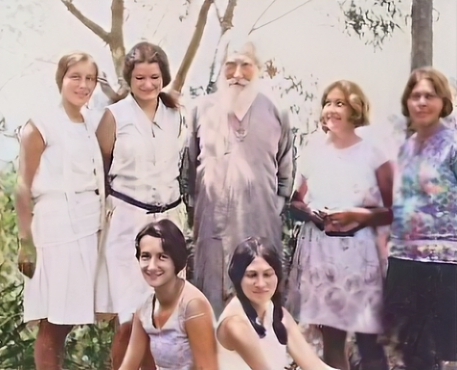
CWL with six of "The Seven Virgins of Java“
The enthusiasm for the coming World Teacher and The Order of the Star in the East came to a dramatic end in 1929 when, in August, Krishnamurti announced his resignation from his intended role as the vehicle for the World Teacher at the Star Camp in Ommen in the Netherlands and dissolved the Order. At that time, Leadbeater was on a lecture tour in India. Although this must have hit him hard, he was, as always, remarkably composed.
In the fall of 1929, he moved back to Adyar from Australia. His longtime friend and confidante Annie Besant died in 1933, and he himself died in Perth, Western Australia, in 1934. In accordance with his wishes, his body was cremated and his ashes scattered in three places: first in Adyar, India, in the garden of the headquarters of the Theosophical Society; second in Kew, a suburb of Melbourne, Australia, where he lived and worked for many years; and third in the Himalayas, at a place dear to him that was associated with the Ascended Masters.