The higher planes of life
Leadbeater was able to perceive the higher worlds or planes of reality and wrote extensively about them. Since not everyone is familiar with the higher planes, I have written a brief introduction here to aid in understanding his writings:
The physical universe as we know it is only a small part of reality. In fact, there are many other planes of existence that are just as real as our physical plane. They are more subtle, as they vibrate at higher frequencies, and we cannot normally perceive them with our physical senses because our senses are tuned to the frequency range of the physical plane. We distinguish a total of seven planes or worlds, of which our physical plane is the lowest.
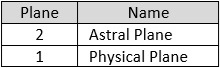
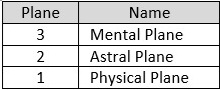
The higher planes of life are in the same place as our physical plane, comparable to different radio programs on different frequencies that interpenetrate each other without interfering. So they are not spatially separated from each other, but because it is easier to understand their structure if you imagine them as layered on top of each other, I would like to use this image here.
The plane immediately above our physical plane is called the astral plane or astral world. This is the plane we go to at night when our physical body sleeps, and the plane we will enter when we eventually shed our physical body. It is the world of emotions and passions.
The next higher level used to be called Devachan or the heavenly world, but now the term mental world or mental level has become more common, since it is the world of thoughts. When our lifetime in the astral world has come to an end, we also leave our astral body and move on to the mental world, where we remain much longer than on the physical and astral levels.
Each plane consists of seven divisions or subplanes, with the lowest being the densest and the highest being the most subtle.
In addition to the solid, liquid, and gaseous subplanes that we can perceive with our physical senses, our physical plane also includes four etheric subplanes. The lowest of these is closest to the frequency that we can still see with our physical eyes, while the highest of the four is closest to the lowest sub-level of the astral world.
Which of the seven sub-levels of the astral world we enter after finally leaving our physical body depends on our development. Undeveloped people come to the lowest sub-plane, the three layers above it correspond to our physical world, and the three highest sub-planes are finer than our physical world.
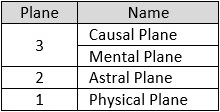
The third main plane, the mental world, consists of two different areas, the lower four sub-planes forming one area and the upper three sub-planes forming the other. The lower realm is the home of concrete thoughts (“Rûpa”) and the upper realm is the home of abstract thoughts (“Arûpa”). The upper realm is also called the causal plane or causal world. Together, the mental and causal planes form the third of the seven worlds.
Initially, names borrowed from Sanskrit were used for the planes, but later on, separate names were introduced. The following table provides an overview of the names used:
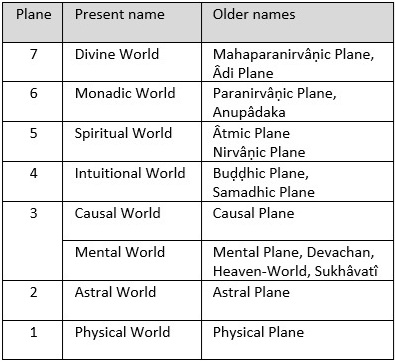
Since even the most highly developed clairvoyants can currently only perceive the lower five worlds, there is little information available about the two upper worlds.
Leadbeater has written articles about the higher planes, which are collected in the recently published book Selected Articles - Volume 1: The Higher Worlds. The book is like a timeless map of the higher worlds for all those who want to know where the journey of our existence will take us in the course of our spiritual development.